
2025 Toyota Tacoma Hybrid Dash Cam and Tailgate Camera Installation
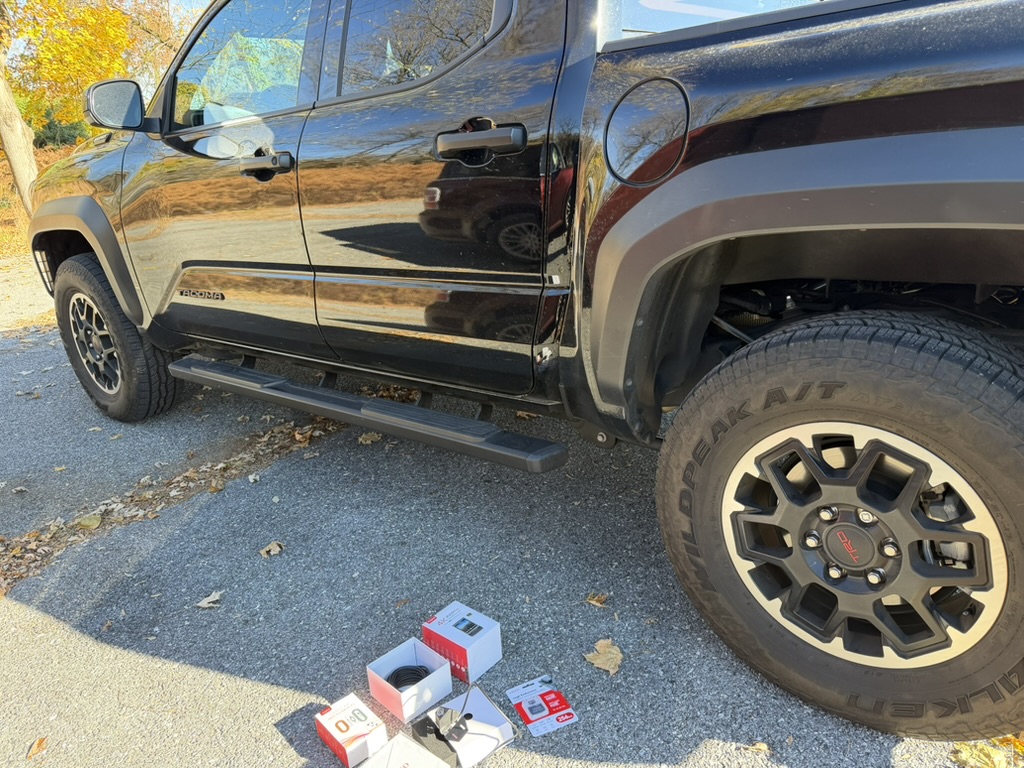
This documented DashcamCraft installation involved a 2025 Toyota Tacoma TRD Off-Road i-FORCE MAX Hybrid, a VIOFO A229 Pro dash camera, a VIOFO HK4 hardwire kit, a 256GB high-endurance memory card and an exterior camera routed toward the tailgate. The project illustrates why a modern pickup—particularly a hybrid—requires more than a generic camera-mounting procedure.
The technical work included locating the low-voltage fuse panel, validating suitable power behavior, concealing wiring through the cabin, moving an exterior-camera cable through a resistant body grommet and securing the outside route in a manner consistent with the truck’s factory harness strategy. The photographs on this page are from the actual completed vehicle, not manufacturer or stock images.
A modern Tacoma is not a generic wiring job
A fourth-generation Tacoma combines tightly packaged trim, electronically managed low-voltage systems, supplemental-restraint components, driver-assistance equipment and, in the i-FORCE MAX, a high-voltage hybrid system. A professional installer must treat the camera as an electrical and mechanical integration project rather than an accessory that can be connected by appearance or online fuse-chart assumptions.
This project required four separate decisions: where to position the forward camera without obstructing the driver or factory sensing equipment; how to establish the correct low-voltage power references; how to route wiring without entering airbag deployment paths; and how to move the exterior-camera cable from the sealed cabin to the tailgate area without compromising the body grommet.
For a broader explanation of pickup-specific labor and cable length, see our SUV and pickup dash cam installation guide.
The fuse panel was on the passenger side
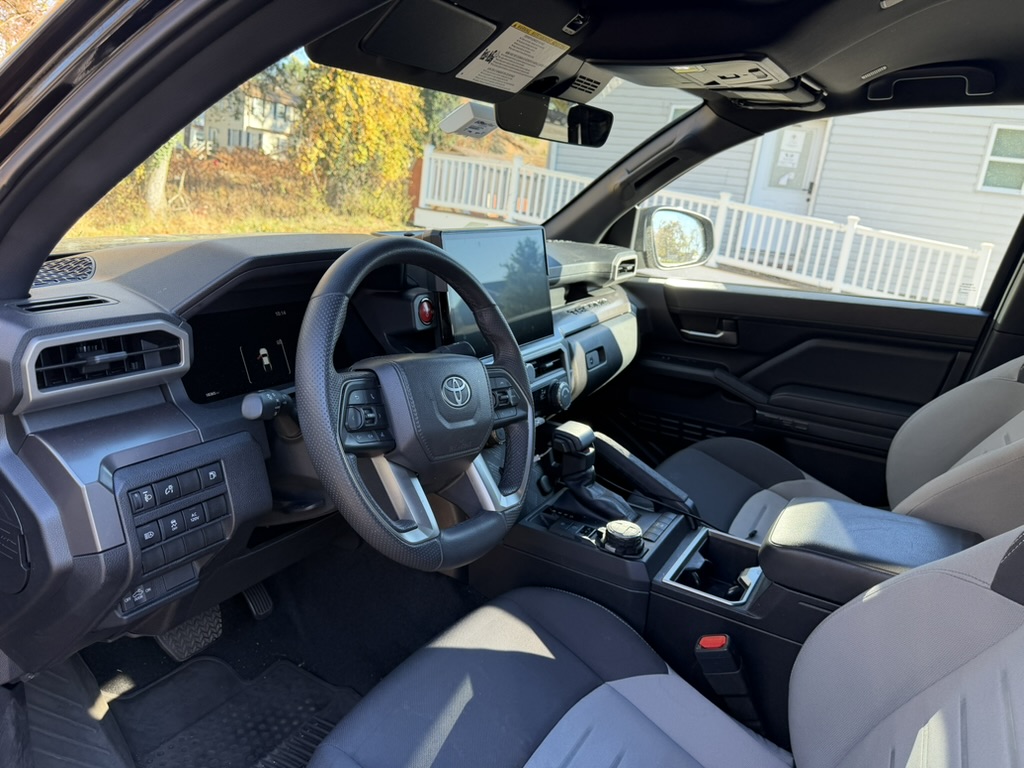
One of the first vehicle-specific differences was fuse-panel access. Installers commonly begin their search beneath the driver-side dashboard because many vehicles place an interior fuse block near the steering column or driver kick panel. On this 2025 Tacoma, the relevant interior fuse area was instead located on the passenger side.
That location changes the installation plan. The installer must account for glove-box and passenger-side trim access, the route from the windshield camera to the power module, nearby factory connectors and the correct path for returning or continuing other system cables through the cabin.
Finding the fuse block is only the beginning. It does not identify which circuits are appropriate. A modern hardwire installation requires electrical testing of each candidate circuit in multiple vehicle states. The installer must distinguish constant battery power from true ignition-switched behavior and must consider that an electronically managed vehicle can keep circuits awake temporarily after shutdown.
Why selecting a fuse is not simple
A professional should verify circuit behavior with appropriate test equipment rather than relying only on a printed label, fuse color, physical position or an unverified diagram. The source and load sides of the circuit matter, as does the orientation of an add-a-fuse connection. The original vehicle circuit must retain its specified protection, while the new camera circuit requires correctly sized protection of its own.
Circuits associated with supplemental restraints, braking, steering, stability control, hybrid management, communications networks or other safety-critical systems are not acceptable choices merely because voltage is present. The installer must also inspect grounding quality, connector security, cable strain relief and the hardwire kit’s low-voltage cutoff configuration.
DashcamCraft’s parking-mode hardwire service explains why the camera, kit, battery condition, cutoff strategy and selected circuits have to work as one system. The VIOFO HK4 hardwire kit used here is compatible with supported VIOFO cameras, but compatibility does not eliminate the need for vehicle-specific testing.
Hybrid-system separation and low-voltage planning
The i-FORCE MAX powertrain makes system separation especially important. A dash camera belongs on the truck’s appropriate low-voltage accessory system; it does not connect to the traction battery or high-voltage hybrid components. Orange high-voltage cables, protected connectors and related hardware must not be disturbed, repositioned or used as convenient supports for aftermarket wiring.
Parking recording also requires conservative planning. A hardwire kit’s cutoff feature can reduce the risk of excessive low-voltage battery discharge, but it cannot make battery condition, temperature, drive duration and parking time irrelevant. The intended parking mode should be discussed before installation and then verified during handover.
Read our technical guide to installing a dash cam in an EV or hybrid vehicle for the distinction between the low-voltage accessory system and the high-voltage traction system.
Moving the camera cable from the cabin to the exterior
The most demanding part of this Tacoma project was not the front-camera mount. It was transferring the exterior-camera cable through the body boundary so it could continue toward the bed and tailgate.
A factory grommet protects existing wiring as it passes through sheet metal. It also contributes to the vehicle’s seal against moisture, road contamination, fumes and noise. The grommet on this Tacoma offered substantial resistance when the camera connector was introduced. That resistance could not be treated as permission to apply more force.
Forcing a connector through a crowded grommet can damage the connector, displace the seal, injure factory conductors or leave the new cable bearing against a metal edge. A blind puncture can be even worse because the installer cannot see the factory loom on the opposite side.
The correct professional response was to stop, inspect the passage from both sides, understand the direction of the original loom and guide the new cable through a protected part of the opening. Connector diameter, bend radius and pulling tension all had to be controlled. After the transfer, the grommet had to remain seated around the wiring so the cabin boundary was not left open.
Following the factory routing strategy outside the cab
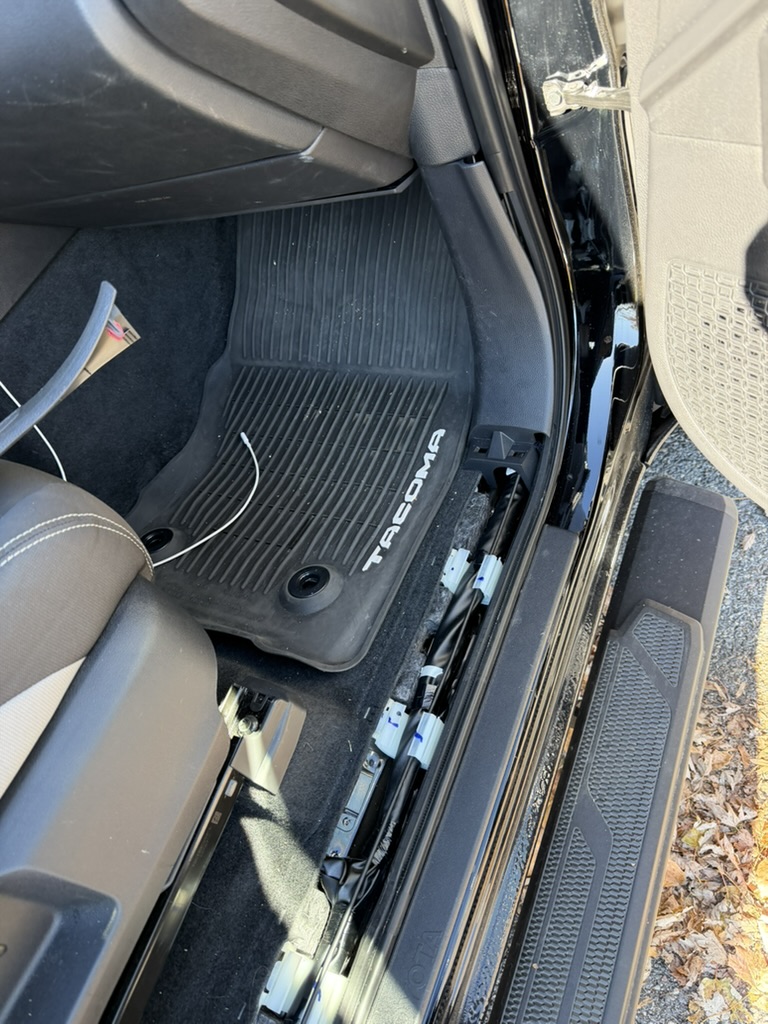
Once the cable reached the exterior, its route had to be planned around heat, water, road debris and moving vehicle parts. Following the direction of an appropriate factory loom can provide a useful routing reference, but an aftermarket cable should not simply be attached to every visible harness.
The full route must be inspected for exhaust heat, suspension travel, drivetrain movement, drainage points, sharp edges and areas where service technicians may later lift or support the truck. The cable also requires abrasion protection and support at intervals that prevent sagging or vibration against the body.
At the tailgate, the cable needs controlled flexibility. Too little slack transfers tailgate movement directly to the camera connector. Too much unsupported slack can snag, chafe or become trapped. A professional route uses a deliberate service loop, strain relief and a mounting position that permits normal opening and closing without loading the cable.
Camera position, trim routing and restraint-system awareness
The forward camera was positioned high in the windshield area to obtain a useful road view while minimizing interference with normal sightlines. Final placement must account for the rearview-mirror housing, windshield-wiper coverage, factory sensors, access to the memory card and the short exposed section of cable near the camera.
Concealed wiring should not be pushed indiscriminately behind pillar trim. Side-curtain airbags and their retention hardware occupy areas commonly used for camera cables. The cable needs to remain behind or away from the deployment path according to the vehicle’s construction, and removed trim must be reinstalled without damaged clips or trapped wiring.
Why this installation belongs with a professional
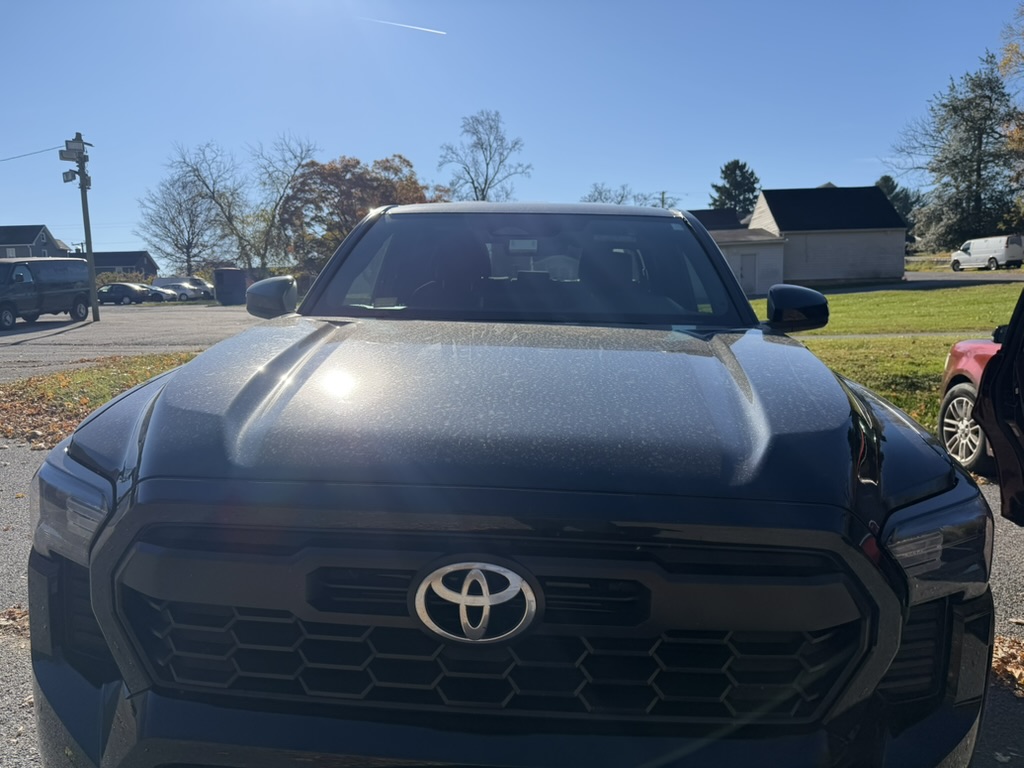
This project combines several risks that are easy to underestimate: passenger-side fuse-panel access, circuit-state testing, add-a-fuse orientation, hybrid-system separation, restraint-system routing, a resistant body grommet, exterior cable protection and tailgate movement.
A professional installation is not defined only by whether the camera turns on. It is defined by whether the camera receives the intended power behavior, the factory circuits remain correctly protected, the ground is mechanically and electrically sound, the trim and airbags remain uncompromised, the body seal remains effective and the exterior wiring survives normal vehicle operation.
The final handover should include verification of normal recording, memory-card recognition, camera angles, parking-mode transition where requested, low-voltage settings, tailgate movement and cable security. The customer should also be shown how to retrieve footage and protect an important recording before loop recording overwrites it.
Use the DashcamCraft storage calculator to estimate how recording resolution, channel count and daily operation affect retention on a memory card.
Request a Toyota Tacoma dash cam installation
DashcamCraft installs customer-supplied front, rear, cabin and exterior camera systems when the equipment is compatible with the vehicle and the requested operating mode. For a Tacoma or other pickup, provide the exact year, trim, camera model, number of channels, hardwire-kit model and whether the rear camera will be inside the cab or mounted externally.
Review our professional dash cam installation service, explore Maryland installation coverage or contact DashcamCraft with your vehicle and equipment details.
DashcamCraft
438R Main Street
Reisterstown, MD 21136
Phone: 443-201-1259